Product Category

Cooking Equipment

Clarify the cooking duty, production method, output requirement, utilities, ventilation, and installation conditions; identify the relevant equipment family; and prepare the technical and commercial details needed for review.

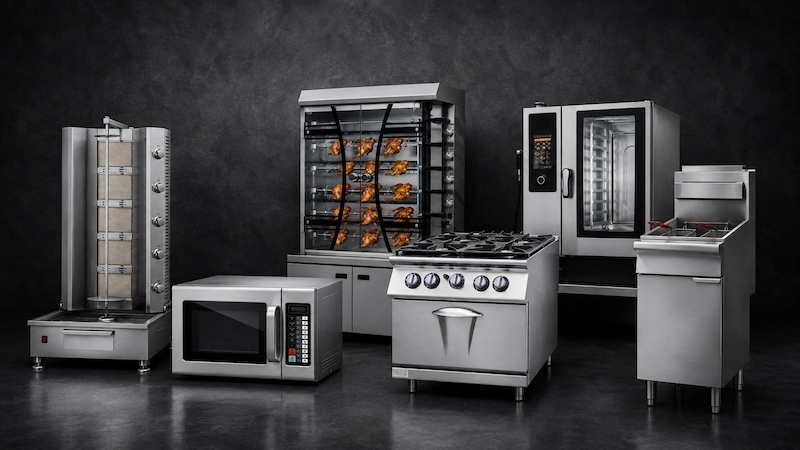
Commercial cooking equipment arranged for cookline, grilling, rotisserie, and enclosed cooking requirements

CATEGORY BOUNDARIES

Define the cooking scope

Separate thermal cooking and finishing requirements from snack production, bakery processing, passive fabrication, and hot holding before selecting an equipment family.

Cooking versus Snack & Fast Food

Use Cooking Equipment for broader thermal cookline, grilling, steaming, roasting, finishing, and enclosed-cooking duties. Use Snack & Fast Food Equipment for product-specific counter production, concession preparation, service display, or holding.

Compare Snack & Fast Food Equipment
Cooking versus Bakery

Use Cooking Equipment for general commercial cooking and finishing duties. Use Bakery Equipment for dough processing, proofing, baking, and bakery-specific production workflows.

Compare Bakery Equipment
Cooking versus Stainless Steel

Use Cooking Equipment when the primary function applies heat or performs powered cooking. Use Stainless Steel Products for passive work surfaces, sinks, storage, fabrication, racks, carts, and related production support.

Compare Stainless Steel Products
Production cooking versus hot holding or display

Clarify whether the requirement cooks or finishes the product, or primarily maintains, presents, or serves an already prepared hot item.

Open cookline versus enclosed cooking

Distinguish open-surface, vessel, grill, or wet-cooking duties from enclosed, combination, microwave, or rapid-cooking requirements.

Heat source, utilities, and installation

Identify the known electrical, gas, steam, water, ventilation, exhaust, clearance, and installation conditions that may affect configuration review.

FAMILY QUALIFICATION LEDGER

Review Cooking Equipment families

Use the cooking duty, heat application, production method, and required output to identify the most relevant family before reviewing model or configuration details.

Qualification noteProduct Type references help prepare a sourcing discussion. Configuration and applicability are confirmed against the selected request.

  1. Cookline and wet cooking

    Use this family for cookline, frying, griddling, vessel-based, wet-cooking, steaming, or related heated production requirements.

    Product Type references

    • Commercial Restaurant Range
    • Commercial Fryer
    • Commercial Griddle
    • Pasta Cooker
    • Bain Marie
    • Commercial Food Steamer
    Selection variables
    • Food product and cooking duty
    • Required cooking or holding process
    • Batch, vessel, surface, or output requirement
    • Heat source and utility conditions
    • Ventilation, operator access, cleaning, and line integration
  2. Grilling and finishing

    Use this family for grilling, contact cooking, overhead finishing, browning, or related surface-based cooking requirements.

    Product Type references

    • Commercial Grill
    • Salamander Grill
    • Two Side Grill
    • Commercial Panini Grill
    Selection variables
    • Food product and required finish
    • Open, contact, or overhead cooking method
    • Cooking surface or product dimensions where known
    • Output pace and operating cycle
    • Heat source, ventilation, access, and cleaning considerations
  3. Rotisserie and specialty cooking

    Use this family when the primary process rotates, roasts, or cooks a product through a dedicated vertical or enclosed specialty workflow.

    Product Type references

    • Shawarma Machine
    • Rotisserie Oven
    Selection variables
    • Food product and loading format
    • Vertical, rotating, or enclosed process
    • Required batch or output
    • Heat source and utility conditions
    • Access, collection, cleaning, and service workflow
  4. Enclosed and rapid cooking

    Use this family for enclosed, combination, toasting, microwave, or rapid-cooking requirements where the operating method and production cycle require configuration review.

    Product Type references

    • Commercial Toaster
    • Combi Oven
    • Rapid Cook Oven
    • Commercial Microwave Oven
    Selection variables
    • Food product and cooking result
    • Operating method and cooking cycle
    • Batch, chamber, tray, or portion requirement
    • Electrical, steam, water, or ventilation conditions where relevant
    • Loading, access, cleaning, and surrounding workflow

REQUEST PREPARATION

Prepare the Cooking Equipment requirement

Bring the cooking duty, output, utility, ventilation, site, destination, and commercial details below into the sourcing discussion so product and configuration applicability can be reviewed.

  1. Preparation chapter

    Cooking duty and production brief

    Define what must be cooked, how heat is applied, and what operating result is required.

    Food product or menu item
    Identify the food, ingredient, prepared product, or menu item involved in the request.
    Cooking or finishing method
    State whether the requirement involves frying, griddling, grilling, steaming, roasting, rotating, toasting, microwave cooking, combination cooking, finishing, or another thermal process.
    Input condition and loading format
    Describe the product condition, portion, vessel, tray, rack, skewer, surface, or loading format where known.
    Required result and operating cycle
    Describe the intended cooking, browning, finishing, holding, or service result and the expected operating pattern.
    Capacity or output
    Provide the required batch size, hourly output, number of portions, or production pace where known.
  2. Preparation chapter

    Utilities, ventilation, and installation

    Confirm the utility, exhaust, placement, access, and destination conditions that may affect configuration review.

    External dimensions and placement
    Share the available installation dimensions, counter or floor placement, cookline position, and surrounding workspace.
    Electrical requirement
    Provide destination voltage, frequency, phase, and plug requirement where known.
    Gas, steam, water, and drainage
    Where relevant, identify the known gas type, steam, water-supply, or drainage requirement that needs review.
    Ventilation and exhaust
    Describe the available ventilation, exhaust, hood, and surrounding airflow conditions where relevant.
    Access, clearance, and workflow
    Describe loading, operator access, service clearance, cleaning access, and surrounding production-flow constraints.
    Destination market
    Provide the destination country or market so utility, documentation, packing, and applicability questions can be reviewed.
  3. Preparation chapter

    Commercial and sourcing coordination

    Add the order context needed to coordinate a single-category or mixed-category sourcing request.

    Quantity and target timing
    Provide estimated quantities and the required timing or project stage.
    Mixed-category sourcing
    List other equipment categories that need review within the same order or project scope.
    OEM / ODM or Private Label
    State any logo, panel language, packaging, branding, or configuration request that requires review.
    Project equipment list
    Identify whether Cooking Equipment is part of a wider kitchen, bakery, snack, bar, supermarket, or foodservice equipment list.
    Repeat order or reference configuration
    Provide the previous reference, known specification, drawing, model, or required changes from an earlier order or installed equipment.

EVIDENCE CHECKPOINT

Define the evidence needed for review

Ask which product, configuration, utility, installation, inspection, packing, and destination-market references can be provided or confirmed for the selected request.

  • Model specifications

    Ask which model-level specifications can be reviewed for the selected Product Type and configuration.

  • Dimensional drawings

    Confirm whether dimensional or installation drawings can be provided for the selected model or configuration where applicable.

  • Electrical, gas, and utility information

    Request the available voltage, frequency, phase, plug, power, gas, steam, water, and drainage information relevant to the selected equipment.

  • Ventilation and installation references

    Ask which ventilation, exhaust, clearance, placement, or installation references may be reviewed for the selected model and site conditions where applicable.

  • Inspection and packing references

    Ask what product-specific inspection, protection, packing method, or order references may be available and what must be confirmed before shipment.

  • Destination-market documentation applicability

    Confirm which destination-market documentation or certification requirements need review for the selected product, model, market, and order.

REQUEST HANDOFF

Continue with a Cooking Equipment request

Bring the relevant family or Product Type references together with the cooking duty, output, utilities, installation, destination, and commercial details needed for review.

Include in the written requirement

  • Relevant Cooking Equipment family or Product Type names
  • Food product, cooking method, loading format, and required result
  • Capacity, dimensions, utilities, ventilation, access, and installation conditions
  • Destination country or market, quantities, and target timing
  • Mixed-category, OEM / ODM, Private Label, project-equipment-list, or repeat-order context where applicable

The Products inquiry provides fields for the request details. Include the Cooking Equipment context in the written requirements so it can be reviewed with the selected sourcing intent.